






 Trap
 Normal
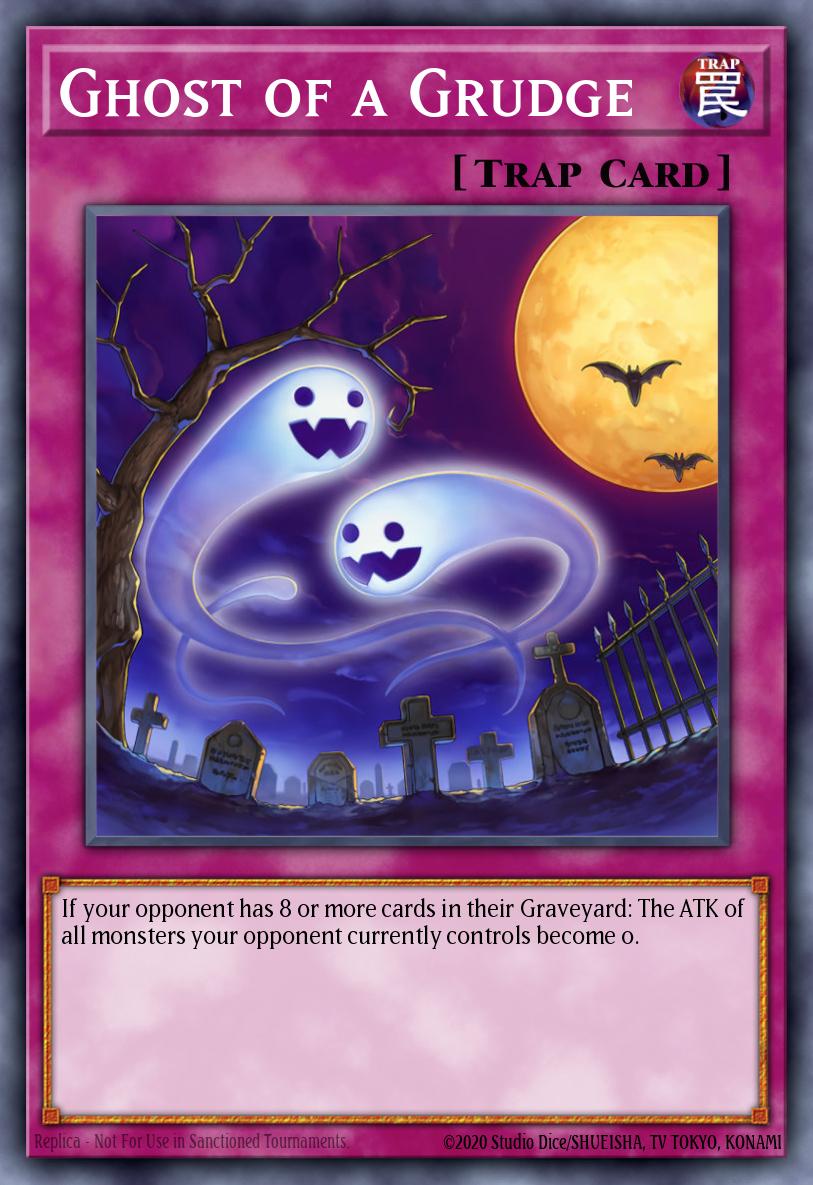
Ghost of a Grudge
View:
3164
If your opponent has 8 or more cards in their Graveyard: The ATK of all monsters your opponent currently controls become 0.
Ghost of a Grudge — Power Evaluation
Final Score: 55 ± 8 · Confidence: Medium
- Intrinsic: 55 · Deck: 55 · Meta: provisional
- Primary role: Board breaker / Going-second · Secondary: Floodgate/Control
Why it scores here
Ghost of a Grudge is a conditional trap: once the opponent has 8 or more cards in their Graveyard, it sets all of their monsters' ATK to 0. Its score comes from that board-breaking effect, its use across 201 recent decks in 22 archetypes, and a cheap one-copy slot. The text gives no combo, material or card-advantage value, so those axes stay low. The sample's high co-occurrence with Keeper of Dragon Magic and Monster Reborn reflects how often those staples appear, so it does not add to the score.
Axis scores
| Axis | Score | Evidence |
|---|---|---|
| Accessibility | 55 | A trap that must be set and has a graveyard-count condition, but it is played in 201 of 201 sampled decks across 22 archetypes with an average of 1.11 copies (observed + verified). |
| Combo & Conversion | 30 | No recorded combo boards exist, so any conversion is text-only inference: it turns the board off rather than building one (inferred). |
| Resource Economy | 30 | A one-for-zero trap with no draw, search, or recursion stated in the text (verified). |
| Effect & Interaction | 60 | Blanks the ATK of every monster the opponent controls, a broad effect, but it is conditional and can be negated while set (verified + inferred). |
| Material Utility | 5 | A trap card with no material or level body, so it provides no material value (verified). |
| Resilience & Flexibility | 40 | Set-card vulnerability and the graveyard threshold limit its uptime, though it works across the field once active (inferred). |
| Deck-Building Efficiency | 70 | A single-copy trap with no garnet, lock, or restriction, so it is cheap to run (verified + observed). |
Calculation
Weight profile: 0.7 Board breaker / Going-second + 0.3 Floodgate/Control. Intrinsic ≈ 55, Deck ≈ 55, Meta = provisional. Modifiers: none. Final formula: 0.40*Intrinsic + 0.60*Deck
Strengths
- Turns off the opponent's whole monster field at once, not just one target
- Appears in 201 sampled decks across 22 archetypes, so it has a home in many lines
- Single-copy, low slot cost, and no garnet or restriction
Weaknesses
- Conditional on the opponent having 8 or more cards in the Graveyard
- Set-card trap, so it can be negated or disrupted before it resolves
- Does not affect the opponent's effects, only their monsters' ATK
- No material or card-advantage value
Counters / choke points
- Opponent negation of the set trap
- Keeping the opponent's Graveyard below 8 cards
- Effects that do not depend on ATK
Best use
Board breaker that blanks the opponent's monsters once their Graveyard reaches 8 cards. Decks: Branded, Bystial/Byssted, Wicked God, Borrel, Despia. Suggested copies: 1.
Evidence & gaps
- Verified: Text: if the opponent has 8 or more cards in their Graveyard, all monsters they control have ATK 0; Card type is Trap Card; formats are TCG, OCG, MasterDuel, DuelLinks; 201 sampled decks, 22 distinct archetypes, average 1.11 copies per deck, max 3; Runs in the main deck in all 201 sampled decks; 0 in the side deck
- Observed: Deck inclusion is spread across Branded (27.9%), Bystial/Byssted (18.9%), and Wicked God (16.9%); Gameplay type 7 accounts for 94% of the sampled decks; Partner co-occurrence of 84–89% with several staples in the sample
- Inferred: Board breaker role: the effect blanks opposing monsters' ATK rather than negating effects; Conditional uptime depends on the opponent's Graveyard reaching 8 cards; Accessibility is solid because it is a set trap in many lines, but it is not guaranteed on any given turn
- Data gaps: no combos supplied; combo conversion is text-only inference no guides supplied no banlist token; assumed 3 copies (unlimited) no usage statistics (StatisticsCard); archetype inclusion is inferred from the deck sample only trap timing (continuous vs. normal) is not stated in the evidence